EsoTv

Showing posts with label Video. Show all posts

Swimmy the Bodhisattva Fish

Swimmy - Cartoon On Working Together - All For One and One For All. Alone, they are vulnerable fish, together, in a group with a common cause they are a gigantic fish. This reminds of my Buddhist faith, Nam-myoho-renge-kyo, therefore I edited this old 16mm film with a modern touch. We all need to shine together now more than ever. ~~ Eso Terry

Cancer Again? Not With This Lifeforce!


So I'm waiting for the doctor's office to call me about getting a biopsi of this spot on my lung.  I am in the Veterans Affairs (VA) medical care, and so it's not a doctor's office I can call and say, "I'm Here Waiting!" Still, I fear not, for I remember what President Josei Todo once said: "When you go to a doctor...Medicine King is your own life, the doctor naturally cannot help but provide a cure (WLS-6, 21)."

In the letter to Ota Jomyo, Nichiren Daishonin writes, "The sutra known as the Lotus Sutra is good medicine for the various ills of body and mind (wnd-2, 747)." It is here the Daishonin teaches that the Mystic Law is the supreme "good medicine" for overcoming the sufferings caused by illness and other disturbances of body and mind (May 2020 World Tribune).

Conversely, being in a healthcare system (the VA) where the doctors, nurses, staff, etc. are worked very hard with too many patients for the system, I remember the wise guidance Ikeda Sensei once gave in his "bodhisattva Medicine King" lecture, where he states that when you chant, the protective life force functions so that even an ordinary doctor naturally provides the right cure (May 2021 LB). In this article, Sensei goes on to say, "In fact, illness is an important and integral part of our experience of being alive -- an indispensable part of our journey to becoming happy and attaining Buddhahood in this lifetime." 

In this same article, there is the story of when President Toda scolded the young Ikeda Sensei by saying, "Daisaku! You haven't got an ounce of life force! If your life force is weak, you'll be defeated." President Toda then sat Sensei in front of the Gohonzon and "chanted Nam-myoho-renge-kyo with a force that literally seemed to batter the devil of illness into submission."

Finally, my favorite quote I read over and over, five-years ago when I defeated my first battle with cancer, is the one I'll end here with:

"When you go to a doctor, even if he is incompetent, because Medicine King is functioning in your own life, the doctor naturally cannot help but provide a cure (WLS-6, 21)."

Here is a video of when I came home after having the cancerous tumor successfully removed from an eight-hour surgery by a young surgeon who had never done this surgery before.  Yes, Medicine King was alive in my life then, and is still with my faith and chanting powerful daimoku with a lifeforce that will batter this "devil of illness into submission." My Bodhisattva mission is not over yet.  I'll be here January 2030 to celebrate the one-hundredth year of the Soka Gakkai.  This I am sure of. 

~~ Eso Terry  

Japanese Boy, Taro - 1963 Educational Film

 This is a film from 1963 I had some fun with.  First of all it tells the story of Taro, a boy in the fifth grade.  It shows his life in 1963 Japan.  I added my cartoon character Kim Zog to do part of the voice over because there was a copyright issue with the music behind the speaker in the original version.  I stayed true to him script until Taro visits a shrine with a Buddha in it.  This section of the film tells how most people in Japan in 1963 were both Buddhist and Shinto, I added a line about Nichiren in there, informing the viewer of the "correct teachings of Buddha." Can you guess? 

Enjoy

~~ Eso Terry   

The Similarities Between Daisaku Ikeda and JFK

 Cleaning out some of my old film closets, I came across this testimonial by a 1960's politician describing the "humanistic" qualities of President John F. Kennedy. I couldn't help but notice the similarities between JFK and Daisaku Ikeda, the 3rd President of the Soka Gakkai.  Watch and I think you'll agree. 

~~ Eso Terry

Cause and Effect


Cause and effect. Is it a thing? Because I write this, I have written, and the effect is yet to be seen. One simple fact is that Cause and Effect is a worldly theme. In the Christian Bible, it is written that "You reap what you sow." I think this is the same as the Buddhist Cause and Effect, but it seems to be talking more about the material aspects than the spiritual aspect.

In a nut shell, the law of Cause and Effect underlies the workings of all phenomena. Positive thoughts, words and actions create positive effects in our lives, leading to happiness. On the other hand, negative thoughts, words and actions—those that in some way undermine the dignity of life—lead to unhappiness. This is the general principle of karma.

In Buddhist teachings other than the Lotus Sutra, Buddhist practice is understood as a gradual journey of transformation that unfolds in accordance with cause and effect. This is a process by which the essentially flawed and imperfect common mortal gradually transforms over the course of many lifetimes into a state of perfection—Buddhahood. It is an undertaking that requires painstaking efforts to accumulate positive causes while receiving the effects of past negative causes and avoiding new negative causes.

Nichiren Buddhism, on the other hand, we don't have to wait until a future lifetime to achieve Buddhahood, we achieve it this life by chanting Nam-myoho-renge-kyo

The difference between this life and next lives, is best explained through the concept of the Ten Worlds. This concept describes our inner state of life at any moment in terms of ten “worlds,” from hell to Buddhahood, which we move between constantly depending on how we live our life and respond to our environment. Hence, we are in and out of Buddhahood every day, every minute of our lives. We get cut off in traffic and beep our horn with some swear words, temporary hell; on the other hand, we receive flowers from an admirer we admire, Heaven; and better yet, we share Buddhism with a friend and see her life flourish from this sharing, we are in Buddhahood. 

In the pre-Lotus Sutra teachings, ordinary people carry out Buddhist practice in the nine worlds (cause) and eventually attain Buddhahood (effect). The nine worlds disappear completely, replaced by the world of Buddhahood. The Lotus Sutra, on the other hand, clarifies that Buddhahood and the other nine worlds are each eternally inherent possibilities of life at each moment. Through faith and practice, the world of Buddhahood, which is otherwise dormant, is brought forth and the nine worlds go into a state of dormancy, though they never completely disappear.

This revolutionary perspective on “attaining” Buddhahood is expressed in the concept of the simultaneity of cause and effect. The nine worlds (“cause”) and the world of Buddhahood (“effect”) are in fact equally inherent potentialities existing simultaneously in our lives. This concept is symbolized by the lotus plant, which, unlike other plants, bears flowers (symbolizing the ordinary person) and fruit (symbolizing Buddhahood) at the same time.

In other words, from the perspective of the Lotus Sutra, delusion and enlightenment—the ordinary person and the Buddha—are two aspects, or possibilities, that are always equally inherent in life. Our inability to perceive our inherent Buddha nature—the idea that Buddhahood is somehow remote from our ordinary reality—is simply a delusion, a result of negative causes that have accumulated in or lives over many existences. However, through the correct Buddhist practice, anyone can activate their Buddha nature.

In conclusion, I think, therefore I am a Buddha, and so are you, you just need to awaken it.  

Here is an old film from the 70's which describes the Buddha's enlightenment in modern terms. Please note the cause and effect part, where the Shakyamuni finds his enlightenment is from within.  

 ~~ Eso Terry  


Leeds England, an Educational Film from the 1970's.

 Here at Kosen-Rufu.com we follow some of the last words the original Buddha left us, and this is to educated ourselves, learn all we can. Furthermore, as a global citizen, we share and love each other's cultures, yes, even the British (ha, just kidding, I love Fish, Chips, and the Beatles!). 

Here is a great educational film from the 70's I restored as part of my Kosen-Rufu.Com collection.  Enjoy. 

~~ Eso Terry 


The Colorless World and the Rainbow. A Children's Cartoon.

 ON a planet far, far away, there was a colorless planet until the colors came together to make things better.  A very Buddhist message for our children.  Of course, this is a message for all people if you ask me, but then again, I am a Buddhist. 

Terry V

Chant Gongyo with English Translation in Realtime

 I always wanted to have an English translation during my chanting Gongyo twice a day. I hope you find this useful. We don't need to know what the words mean to get benefit, but it's nice to know what they mean. Nam-Myoho-Renge-Kyo is the answer, no matter the question.

Global Citizen is the bases of Nichirin Buddhism.

This morning I posted my live thoughts on "Morning Buddhist Thoughts" on being a global citizen. The definition of a global citizen is:

Global citizenship is a form of transnationality, specifically the idea that one's identity transcends geography or political borders and that responsibilities or rights are derived from membership in a broader global class of "humanity". This does not mean that such a person denounces or waives their nationality or other, more local identities, but that such identities are given "second place" to their membership in a global community. Extended, the idea leads to questions about the state of global society in the age of globalization.

There you have it in a nutshell what I believe being a Nichiren Buddhist stands for, epesecially the line "a broader global class of 'humanity'".  No national politics can justify the starvation of one human being for power.  We see this everywhere today.  Let's fix this brothers and sisters.  Let's chant Nam-myoho-renge-kyo together and fight for a better world where the value of life is the number one goal of the world. 

Here is the Nichiren Writing I quoted this morning: 

People have varied tastes. Some prefer good and some prefer evil. 

There are many kinds of people. But thought they differ from one another in such ways, once they enter into the Lotus Sutra, they all become like a single person in body and a single person in mind. This is just like the myriad different rivers that, when they flow into the ocean, all take on a uniformly salty flavor, or like the many kinds of birds that, whey they approach Mount Sumeru, all assume the same (golden) hue.

(WND 1042) 

Click For My Morning Buddhist Thoughts


An Extrordinary Home Visit

Jack Smith's life was in the dumps, his car in the shop, job to be cut, and wife has left him. Jimmy Onit is a men's leader, he chants with Jack Smith and everything changes. 

Ten Directions and Three Existence of Buddhism


ten directions [十方] ( jippō): The entire universe, all physical space. Specifically, the ten directions are the eight directions of the compass—north, south, east, west, northwest, northeast, southeast, and southwest—plus up and down. Buddhist scriptures refer to the existence of Buddha lands in all directions throughout the universe, each with its own Buddha. The expression “the Buddhas of the ten directions” in the sutras indicates these Buddhas. The phrase ten directions often appears with the phrase three existences, meaning past, present, and future existences. “The Buddhas of the ten directions and three existences” thus means all Buddhas throughout space and time.

Devadatta

Devadatta was by tradition a Buddhist monk, cousin and brother-in-law of Gautama Siddhārtha. The accounts of his life vary greatly, but he is generally seen as an evil and divisive figure in Buddhism, who led a breakaway group in the earliest days of the religion. 

Devadatta is said to have joined the sangha along with Ananda, who was possibly his brother, in the 20th year of the Buddha’s ministry. Fifteen years later, strengthened by his friendship with the crown prince of Magadha, Ajatashatru, Devadatta proposed formally at a meeting of the sangha that the Buddha retire and hand over the leadership to him. This proposal was rejected, and Devadatta is said to have successfully instigated Ajatashatru to execute Bimbisara, his aged father and the king of Magadha. He is also said to have made three abortive attempts to bring about the Buddha’s death: by hiring assassins, by rolling a rock off a mountainside at him, and by arranging for a mad elephant to be let loose in the road at the time of the collection of alms.

Sensing popular approval, Devadatta proposed stricter ascetic rules for the sangha. When these were refused, he persuaded some 500 of the Buddha’s followers to join in a secession. Nothing further is known about Devadatta’s movement, but it may possibly be referred to under the name of the Gotamakas in the Anguttara Nikaya (a canonical text), for Devadatta’s family name was Gotama (Sanskrit Gautama). The Chinese pilgrim Xuanzang recorded that in the 7th century ce monks of a monastery in Bengal were following a certain regulation of Devadatta’s.

In The Lotus Sutra

“Devadatta” chapter [提婆達多品] ( Daibadatta-hon): The twelfth chapter of the Lotus Sutra. It teaches that both women and evil persons are capable of attaining Buddhahood in their present forms, something generally denied in the provisional, or pre-Lotus Sutra, teachings, as well as the principle of attaining enlightenment without completing many kalpas of practice. In the first half of the chapter, Shakyamuni discloses that in a past life he was a king who renounced his throne to seek the truth. For one thousand years, he served a seer named Asita, who in turn taught him the Lotus Sutra. This seer, he explains, was none other than Devadatta. He then prophesies that, in the distant future, Devadatta will attain enlightenment as a Buddha called Heavenly King. Devadatta had tried on several occasions to kill Shakyamuni and foment disunity within the Buddhist Order and is said to have fallen into hell alive. The prediction of his future enlightenment indicates that even one disposed to evil has the potential to become a Buddha.

Next Bodhisattva Manjushrī relates how he has preached the Lotus Sutra in the palace of a dragon king and converted innumerable beings, and Bodhisattva Wisdom Accumulated asks him if there is anyone there who by practicing the sutra has attained Buddhahood quickly. Manjushrī replies that the eight-year-old daughter of the dragon king has fully attained the supreme Buddha wisdom. Wisdom Accumulated and Shāriputra both challenge this; Wisdom Accumulated on the grounds that Buddhahood requires the practice of austerities spanning many kalpas, Shāriputra for the same reason and because he believes women to be incapable of attaining enlightenment due to the five obstacles. But by now the dragon king’s daughter has appeared in front of them. After presenting a jewel to Shakyamuni Buddha, she at once transforms herself into a male and perfects the bodhisattva practice. Acquiring the thirty-two features and eighty characteristics of a Buddha, he appears in a land to the south called Spotless World, where he preaches the Lotus Sutra to all beings in the ten directions.

Nichiren (1222–1282) explains the significance of the dragon king’s daughter’s enlightenment in The Opening of the Eyes: “When she attained Buddhahood, this does not mean simply that one person did so. It reveals the fact that all women will attain Buddhahood. In the various Hinayana sutras that were preached before the Lotus Sutra, it is denied that women can ever attain Buddhahood. In the Mahayana sutras other than the Lotus Sutra, it would appear that women can attain Buddhahood or be reborn in the pure land. But they may do so only after they have changed into some other form. It is not the kind of immediate attainment of Buddhahood that is based on the doctrine of three thousand realms in a single moment of life. . . . The dragon king’s daughter represents ‘one example that stands for all the rest.’ When the dragon king’s daughter attained Buddhahood, it opened up the way to attaining Buddhahood for all women of later ages”.

The enlightenment of evil people, represented by Devadatta, and that of women, represented by the dragon king’s daughter, illustrate the universal possibility of Buddhahood taught for the first time in the Lotus Sutra. See also dragon king’s daughter.


Morning Buddhist Thought #1 "We Choose to be here. Protection from the Gohonzon."

Dr TV Boogie talks about the Gohonzon, the supreme object of devotion. Protection from Buddhas of the ten directions. *President Toda guidance.


Josei Toda

Josei Toda (1900-58) was an educator, publisher and entrepreneur who, as second president of the Soka Gakkai, revived the lay Buddhist organization after the Second World War, building it into a dynamic, popular movement.

Encountering his Mentor

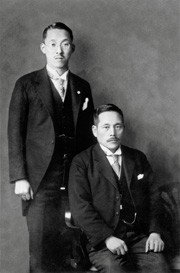
Makiguchi (right) and Toda (left), 1930Arriving in Tokyo from the northern island of Hokkaido in his early 20s, Toda found a teaching post at the school where Tsunesaburo Makiguchi was principal. Impressed by Makiguchi's educational ideals, he soon became his protégé. In 1928 he followed Makiguchi in his decision to practice Nichiren Buddhism. The two later cofounded the Soka Kyoiku Gakkai, forerunner of the Soka Gakkai.

Imprisonment

As Japan's militarist authorities tightened control over society and suppressed dissent, Toda and Makiguchi were arrested and imprisoned in 1943 for opposing the government's policies. In prison, Toda devoted himself to the practice and study of Nichiren Buddhism, gaining a profound grasp of its principles. His efforts brought him to a clear realization that Buddhahood is a potential inherent in all life, and deepened his confidence that all people could manifest this enlightened life condition through practicing Nichiren's teachings.


Building the Soka Gakkai

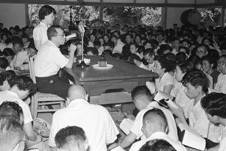
Lecturing on the writings of Nichiren, 1954On his release from prison at the end of the Second World War, Toda began to reconstruct the collapsed Soka Kyoiku Gakkai, renaming it the Soka Gakkai (Society for the Creation of Value). Toda taught that through Buddhist practice and inner-motivated change, or "human revolution," all people can change their destiny for the better. This message resonated powerfully among the many people suffering from poverty, illness and other challenges in the chaos of postwar Japan. Moreover, Toda's unshakable confidence in the power of Nichiren's philosophy and his ability to translate the profound concepts of Buddhism into practical guidance for daily life re-ignited people's hope and courage. By the time of his death in 1958 Toda had built an organization of nearly one million members and laid the foundation for the dramatic spread of Nichiren Buddhism in Japan and abroad.

Peace Legacy

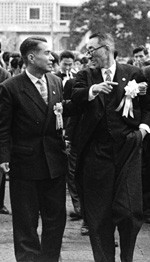
Toda & Daisaku Ikeda (1958)Toda is also remembered for his uncompromising stance against nuclear weapons, which he termed an absolute evil that threatens people's inalienable right to life. He urged the youth members of the Soka Gakkai to work for the abolition of nuclear weapons. This stance, which he declared in 1957, is considered the inspiration for the SGI's peace activities. In honour of Toda's ideals, his successor, SGI President Ikeda, founded the Toda Institute for Global Peace and Policy Research. The institute brings peace researchers, policy-makers and community activists together on projects related to peace-building and dialogue among civilizations.


Morning Buddhist Thought, Jan 21, 2025


January 20th, Morning Budhist Thoughts on Dreams

IN this morning thoughts I cover the dream that inspired me to begin recording my morning thoughts live from in front of my altar, before I chant morning Gongyo  (Nam-Myoho-Renge-Kyo).  I hope you find this inspirational.  We're all Buddhist. We're all equal. We are love.

Swimmy the Bodhisattva Fish

Swimmy - Cartoon On Working Together - All For One and One For All. Alone, they are vulnerable fish, together, in a group with a common caus...