EsoTv

Showing posts with label Live. Show all posts

Dengyo


Dengyō [伝教] (767–822): Also known as Saichō. The founder of the Tendai school in Japan. His posthumous honorific name and title are the Great Teacher Dengyō. At age twelve, he entered the Buddhist priesthood and studied under Gyōhyō at a provincial temple in Ōmi Province. In 785 he attended the ceremony for receiving the entire set of Hinayana precepts at Tōdai-ji temple in Nara, and in the seventh month of the same year he went to Mount Hiei where he built a small retreat. There he studied Buddhist scriptures and treatises, especially those of the T’ien-t’ai school.
  In 788 he built a small temple on the mountain and named it Hieisan-ji (Temple of Mount Hiei). (After Dengyō’s death, Emperor Saga renamed it Enryaku-ji in 823.) In 802, at age thirty-six, Dengyō was invited to Kyoto by the brothers and court nobles Wake no Hiroyo and Wake no Matsuna to lecture at their family temple, Takao-dera. There he expounded T’ien-t’ai’s three major works to eminent priests representing the seven major temples of Nara. This event catapulted Dengyō to prominence, winning him the support of Emperor Kammu, and greatly enhanced the prestige of the T’ien-t’ai doctrine.
  In 804, accompanied by his disciple Gishin who acted as interpreter, Dengyō went to China. After making a pilgrimage to Mount T’ien-t’ai, the center of the T’ien-t’ai school, they stayed in the province of T’ai-chou, where the center was located. There Dengyō received the essentials of T’ien-t’ai Buddhism from Miao-lo’s disciple Tao-sui and then from Hsing-man, another disciple of Miao-lo. He also received the bodhisattva precepts, or those of perfect and immediate enlightenment, from Tao-sui, the Zen teachings from Hsiao-jan, and the anointment of Esoteric Buddhism from Shun-hsiao. In 805 he returned to Japan and the next year established the Tendai school. In those days, all Buddhist priests were ordained exclusively in the Hinayana precepts. Dengyō wished to ordain his disciples with Mahayana precepts and made continual efforts to obtain imperial permission for the building of a Mahayana ordination center on Mount Hiei in the face of determined opposition from the older schools of Nara. Permission was finally granted a week after Dengyō’s death in 822, and in 827 his successor Gishin completed the ordination center.
  After his return to Japan, in addition to this project, Dengyō concentrated his efforts on refuting the doctrines of the older Buddhist schools. In particular, his ongoing debate with Tokuitsu, a priest of the Dharma Characteristics (Hossō) school, is well known. That debate began in the early Kōnin era (810–824). Tokuitsu asserted that the one vehicle teaching of the Lotus Sutra was a provisional teaching that Shakyamuni Buddha expounded in accordance with the people’s capacity, while the three vehicle teachings were true teachings, and that there are some people who are without the potential to attain Buddhahood. In opposition to this assertion, Dengyō maintained that all people have the Buddha nature, and that the one vehicle of Buddhahood expounded in the Lotus Sutra is the true teaching.
  Among Dengyō’s major disciples were Gishin, Enchō, Kōjō, Jikaku, Chishō, and Ninchū. His works include The Outstanding Principles of the Lotus Sutra, A Clarification of the Precepts, An Essay on the Protection of the Nation, and The Regulations for Students of the Mountain School.

Ten Directions and Three Existence of Buddhism


ten directions [十方] ( jippō): The entire universe, all physical space. Specifically, the ten directions are the eight directions of the compass—north, south, east, west, northwest, northeast, southeast, and southwest—plus up and down. Buddhist scriptures refer to the existence of Buddha lands in all directions throughout the universe, each with its own Buddha. The expression “the Buddhas of the ten directions” in the sutras indicates these Buddhas. The phrase ten directions often appears with the phrase three existences, meaning past, present, and future existences. “The Buddhas of the ten directions and three existences” thus means all Buddhas throughout space and time.

Morning Buddhist Thought #1 "We Choose to be here. Protection from the Gohonzon."

Dr TV Boogie talks about the Gohonzon, the supreme object of devotion. Protection from Buddhas of the ten directions. *President Toda guidance.


Josei Toda

Josei Toda (1900-58) was an educator, publisher and entrepreneur who, as second president of the Soka Gakkai, revived the lay Buddhist organization after the Second World War, building it into a dynamic, popular movement.

Encountering his Mentor

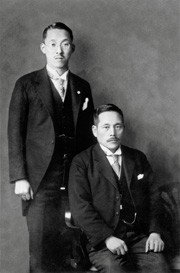
Makiguchi (right) and Toda (left), 1930Arriving in Tokyo from the northern island of Hokkaido in his early 20s, Toda found a teaching post at the school where Tsunesaburo Makiguchi was principal. Impressed by Makiguchi's educational ideals, he soon became his protégé. In 1928 he followed Makiguchi in his decision to practice Nichiren Buddhism. The two later cofounded the Soka Kyoiku Gakkai, forerunner of the Soka Gakkai.

Imprisonment

As Japan's militarist authorities tightened control over society and suppressed dissent, Toda and Makiguchi were arrested and imprisoned in 1943 for opposing the government's policies. In prison, Toda devoted himself to the practice and study of Nichiren Buddhism, gaining a profound grasp of its principles. His efforts brought him to a clear realization that Buddhahood is a potential inherent in all life, and deepened his confidence that all people could manifest this enlightened life condition through practicing Nichiren's teachings.


Building the Soka Gakkai

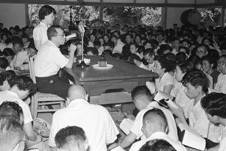
Lecturing on the writings of Nichiren, 1954On his release from prison at the end of the Second World War, Toda began to reconstruct the collapsed Soka Kyoiku Gakkai, renaming it the Soka Gakkai (Society for the Creation of Value). Toda taught that through Buddhist practice and inner-motivated change, or "human revolution," all people can change their destiny for the better. This message resonated powerfully among the many people suffering from poverty, illness and other challenges in the chaos of postwar Japan. Moreover, Toda's unshakable confidence in the power of Nichiren's philosophy and his ability to translate the profound concepts of Buddhism into practical guidance for daily life re-ignited people's hope and courage. By the time of his death in 1958 Toda had built an organization of nearly one million members and laid the foundation for the dramatic spread of Nichiren Buddhism in Japan and abroad.

Peace Legacy

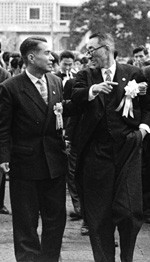
Toda & Daisaku Ikeda (1958)Toda is also remembered for his uncompromising stance against nuclear weapons, which he termed an absolute evil that threatens people's inalienable right to life. He urged the youth members of the Soka Gakkai to work for the abolition of nuclear weapons. This stance, which he declared in 1957, is considered the inspiration for the SGI's peace activities. In honour of Toda's ideals, his successor, SGI President Ikeda, founded the Toda Institute for Global Peace and Policy Research. The institute brings peace researchers, policy-makers and community activists together on projects related to peace-building and dialogue among civilizations.


Morning Buddhist Thought, Jan 21, 2025


January 20th, Morning Budhist Thoughts on Dreams

IN this morning thoughts I cover the dream that inspired me to begin recording my morning thoughts live from in front of my altar, before I chant morning Gongyo  (Nam-Myoho-Renge-Kyo).  I hope you find this inspirational.  We're all Buddhist. We're all equal. We are love.

Japanese Boy, Taro - 1963 Educational Film

 This is a film from 1963 I had some fun with.  First of all it tells the story of Taro, a boy in the fifth grade.  It shows his life in 196...