EsoTv

Showing posts with label Soka Gakkai (SGI). Show all posts

The Similarities Between Daisaku Ikeda and JFK

 Cleaning out some of my old film closets, I came across this testimonial by a 1960's politician describing the "humanistic" qualities of President John F. Kennedy. I couldn't help but notice the similarities between JFK and Daisaku Ikeda, the 3rd President of the Soka Gakkai.  Watch and I think you'll agree. 

~~ Eso Terry

Chant Gongyo with English Translation in Realtime

 I always wanted to have an English translation during my chanting Gongyo twice a day. I hope you find this useful. We don't need to know what the words mean to get benefit, but it's nice to know what they mean. Nam-Myoho-Renge-Kyo is the answer, no matter the question.

Kosen-Rufu Gongyo Karaoke

This is the chant we do for the Soka Gakkai, Nichiren Buddhist practice. The power is in the words, mixed with faith, and a little thing we call "The Mystic" Law. Chant Nam-myoho-renge-kyo and find out for yourself. Put down those magic sticks boys and girls, this is the real elevated divine shit. Go for it. Change your karma today, this lifetime, not the next. 

~~ Eso Terry Nam-Myoho-Renge-Kyo is the answer, no matter the question


Global Citizen is the bases of Nichirin Buddhism.

This morning I posted my live thoughts on "Morning Buddhist Thoughts" on being a global citizen. The definition of a global citizen is:

Global citizenship is a form of transnationality, specifically the idea that one's identity transcends geography or political borders and that responsibilities or rights are derived from membership in a broader global class of "humanity". This does not mean that such a person denounces or waives their nationality or other, more local identities, but that such identities are given "second place" to their membership in a global community. Extended, the idea leads to questions about the state of global society in the age of globalization.

There you have it in a nutshell what I believe being a Nichiren Buddhist stands for, epesecially the line "a broader global class of 'humanity'".  No national politics can justify the starvation of one human being for power.  We see this everywhere today.  Let's fix this brothers and sisters.  Let's chant Nam-myoho-renge-kyo together and fight for a better world where the value of life is the number one goal of the world. 

Here is the Nichiren Writing I quoted this morning: 

People have varied tastes. Some prefer good and some prefer evil. 

There are many kinds of people. But thought they differ from one another in such ways, once they enter into the Lotus Sutra, they all become like a single person in body and a single person in mind. This is just like the myriad different rivers that, when they flow into the ocean, all take on a uniformly salty flavor, or like the many kinds of birds that, whey they approach Mount Sumeru, all assume the same (golden) hue.

(WND 1042) 

Click For My Morning Buddhist Thoughts


Soka Gakkai

The Soka Gakkai began as an organization of reformist Japanese educators inspired by the philosophy of Nichiren Buddhism. Its founder and first president, Tsunesaburo Makiguchi (1871–1944), was driven by a passion to enable people to lead fulfilled and happy lives. During World War II, he was imprisoned with his protégé, Josei Toda (1900–58), by the Japanese militarist government for opposing its policies. Makiguchi died in prison from malnutrition and old age, while Toda emerged to rebuild the Soka Gakkai as a Buddhist movement to empower people suffering in the aftermath of the war. Daisaku Ikeda (1928–2023) inherited Toda’s vision, going on to develop the organization into a multifaceted movement for peace, culture and education with members around the world.

Based on the philosophy and practice of Nichiren’s teachings, the Soka Gakkai advocates an individual inner reformation it calls “human revolution,” the ultimate goal of which is a peaceful world and the happiness of humanity. It upholds the Lotus Sutra philosophy that all people inherently possess within them the Buddha nature, the potential for enlightenment, and can bring it forth through Buddhist practice. Based on this teaching, the Soka Gakkai has been endeavoring to establish the sanctity of life and the dignity of humanity as fundamental universal ideals. 

The Soka Gakkai does not view Buddhism as an exclusively spiritual or metaphysical pursuit, but as an applied philosophy of life. It encourages Buddhist practice as a means for people to develop the character, wisdom, and strength to improve themselves and their circumstances, to contribute to society, and to help bring about happiness and peace in the world.
   

In 2013 the Soka Gakkai opened the Hall of the Great Vow for Kōsen-rufu in Shinanomachi, Tokyo, as the central feature of its Headquarters complex. The central Gohonzon of the Soka Gakkai is enshrined there and members from around the world visit to pray for and renew their resolution to achieve world peace. It houses a conference room commemorating the achievements of the Soka Gakkai's founding presidents, Makiguchi, Toda, and Ikeda.

Sharing Your Buddhist Faith For Beginers.


To share your Nichiren Buddhist faith experience, focus on how chanting Nam-myoho-renge-kyo has positively impacted your life by overcoming challenges, finding inner strength, and contributing to your personal growth, while emphasizing the importance of sharing this practice with others to spread happiness and peace;be genuine, specific about situations where your faith helped, and express your gratitude for the teachings of Nichiren Buddhism and the Soka Gakkai community. 

Key points to include: 

  • Personal challenges:
    Describe a specific situation where you faced a significant obstacle in your life, like a health issue, relationship conflict, or career setback, and how chanting helped you find the courage and resilience to overcome it. 
  • Transformation through chanting:
    Explain how the practice of chanting Nam-myoho-renge-kyo transformed your perspective on the situation and allowed you to approach it with a more positive mindset. 

    Positive changes:
  • Share tangible positive changes in your life that resulted from your faith practice, such as improved relationships, increased confidence, or a greater sense of purpose. 

    Soka Gakkai community support:
  • Mention the importance of your local Soka Gakkai community and how their encouragement and support strengthened your faith journey. 

    Kosen-rufu:
  • Explain the concept of "kosen-rufu" (achieving world peace) and how your personal practice contributes to this larger goal. 

    Structure for sharing your experience: 
  • Introduction:
    Briefly introduce yourself and how you came to practice Nichiren Buddhism. 
  • Personal story:
    Share a specific life experience where your faith made a significant impact, detailing the challenges you faced and how chanting helped you overcome them. 

    Impact on your life:
  • Describe the positive changes you've experienced in your personal life, relationships, and outlook as a result of your practice. 

    Gratitude and inspiration:
  • Express your gratitude for the teachings of Nichiren Daishonin and the Soka Gakkai community, and encourage others to explore the benefits of chanting.  

    Important considerations: 
  • Be authentic: Share your story with genuine emotion and sincerity. 
  • Focus on the positive: Highlight the positive aspects of your faith journey and how it has enriched your life. 
  • Respect others' beliefs: Be mindful of different perspectives and avoid making forceful claims. 
  • Adapt to the audience: Tailor your sharing to fit the context and level of understanding of your listeners. 

Morning Buddhist Thought #1 "We Choose to be here. Protection from the Gohonzon."

Dr TV Boogie talks about the Gohonzon, the supreme object of devotion. Protection from Buddhas of the ten directions. *President Toda guidance.


Josei Toda

Josei Toda (1900-58) was an educator, publisher and entrepreneur who, as second president of the Soka Gakkai, revived the lay Buddhist organization after the Second World War, building it into a dynamic, popular movement.

Encountering his Mentor

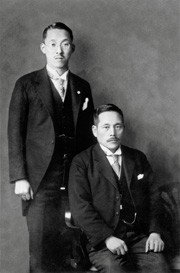
Makiguchi (right) and Toda (left), 1930Arriving in Tokyo from the northern island of Hokkaido in his early 20s, Toda found a teaching post at the school where Tsunesaburo Makiguchi was principal. Impressed by Makiguchi's educational ideals, he soon became his protégé. In 1928 he followed Makiguchi in his decision to practice Nichiren Buddhism. The two later cofounded the Soka Kyoiku Gakkai, forerunner of the Soka Gakkai.

Imprisonment

As Japan's militarist authorities tightened control over society and suppressed dissent, Toda and Makiguchi were arrested and imprisoned in 1943 for opposing the government's policies. In prison, Toda devoted himself to the practice and study of Nichiren Buddhism, gaining a profound grasp of its principles. His efforts brought him to a clear realization that Buddhahood is a potential inherent in all life, and deepened his confidence that all people could manifest this enlightened life condition through practicing Nichiren's teachings.


Building the Soka Gakkai

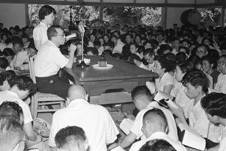
Lecturing on the writings of Nichiren, 1954On his release from prison at the end of the Second World War, Toda began to reconstruct the collapsed Soka Kyoiku Gakkai, renaming it the Soka Gakkai (Society for the Creation of Value). Toda taught that through Buddhist practice and inner-motivated change, or "human revolution," all people can change their destiny for the better. This message resonated powerfully among the many people suffering from poverty, illness and other challenges in the chaos of postwar Japan. Moreover, Toda's unshakable confidence in the power of Nichiren's philosophy and his ability to translate the profound concepts of Buddhism into practical guidance for daily life re-ignited people's hope and courage. By the time of his death in 1958 Toda had built an organization of nearly one million members and laid the foundation for the dramatic spread of Nichiren Buddhism in Japan and abroad.

Peace Legacy

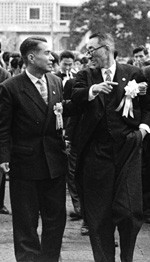
Toda & Daisaku Ikeda (1958)Toda is also remembered for his uncompromising stance against nuclear weapons, which he termed an absolute evil that threatens people's inalienable right to life. He urged the youth members of the Soka Gakkai to work for the abolition of nuclear weapons. This stance, which he declared in 1957, is considered the inspiration for the SGI's peace activities. In honour of Toda's ideals, his successor, SGI President Ikeda, founded the Toda Institute for Global Peace and Policy Research. The institute brings peace researchers, policy-makers and community activists together on projects related to peace-building and dialogue among civilizations.


Japanese Boy, Taro - 1963 Educational Film

 This is a film from 1963 I had some fun with.  First of all it tells the story of Taro, a boy in the fifth grade.  It shows his life in 196...