Josei Toda (1900-58)
Arriving in Tokyo from the northern island of Hokkaido in his early 20s, Toda found a teaching post at the school where Tsunesaburo Makiguchi was principal. Impressed by Makiguchi’s educational ideals, he soon became his protege. In 1928 he followed Makiguchi in his decision to practise Nichiren Buddhism. The two later cofounded the Soka Kyoiku Gakkai, forerunner of the Soka Gakkai.
As Japan’s militarist authorities tightened control over society and suppressed dissent, Toda and Makiguchi were arrested and imprisoned in 1943 for opposing the government’s policies. In prison, Toda devoted himself to the practice and study of Nichiren Buddhism, gaining a profound grasp of its principles. His efforts brought him to a clear realization that Buddhahood is a potential inherent in all life, and deepened his confidence that all people could manifest this enlightened life condition through practising Nichiren’s teachings.
On his release from prison at the end of World War II, Toda began to reconstruct the collapsed Soka Kyoiku Gakkai, renaming it the Soka Gakkai (Society for the Creation of Value). Toda taught that through Buddhist practice and inner-motivated change, or “human revolution,” all people can change their destiny for the better. This message resonated powerfully among the many people suffering from poverty, illness and other challenges in the chaos of postwar Japan. Moreover, Toda’s unshakable confidence in the power of Nichiren’s philosophy and his ability to translate the profound concepts of Buddhism into practical guidance for daily life re-ignited people’s hope and courage. By the time of his death in 1958 Toda had built an organization of nearly one million members and laid the foundation for the dramatic spread of Nichiren Buddhism in Japan and abroad.
Toda is also remembered for his uncompromising stance against nuclear weapons, which he termed an absolute evil that threatens people’s inalienable right to life. He urged the youth members of the Soka Gakkai to work for the abolition of nuclear weapons. This stance, which he declared in 1957, is considered the inspiration for the SGI’s peace activities. In honour of Toda’s ideals, his successor, SGI President Ikeda, founded the Toda Peace Institute (formerly the Toda Institute for Global Peace and Policy Research). The institute brings peace researchers, policy-makers and community activists together on projects related to peace-building and dialogue among civilizations.
Myoho (妙法) Meaning to Me.
妙法 Myoho
I read this passage today from my desktop Daily Wisdom From The Writings of Nichiren Daishonin:
“And yet there is one river called the Sahara that follows a course as straight as a taut rope, flowing directly into the western sea. A woman who has faith in the Lotus Sutra will be like this river, proceeding directly to the Pure Land in the west. Such is the virtue inherent in the single character myo. (WND, 149).”
Wow, there is a lot to unpack there. First, please notice that it says “…faith in the Lotus Sutra…” and not faith in anything else. It doesn't say faith in the Daishonin, a priest, an organization, a spiritual leader, etc., It says faith in the Lotus Sutra. So, brothers and sisters, don't be led astray, and when in doubt, chant Nam-myoho-renge-kyo (NMRK), which is the title of the Lotus Sutra, and one of the things Nichiren Daishonin left us which incompasses all of the Lotus Sutra. Still, I request we read the Lotus Sutra out alloud beside a campfire one day, but I doubt I'll stay awake -- it's not a Nancy Drew novel. So, thank you Nichiren for showing us a way to bypass that 😁. Let's move on.
The thing that stuck out most to me about the above passage is where Nichiren writes: "Such is the virtue inherent in the single character myo." I have herd people say "myo" is the thing, and I always wondered why. And so I researched the topic and here is why:
First, according to Google AI, we read: In Nichiren Buddhism, myo (妙) is the first character of Myoho-renge-kyo (the Mystic Law) and translates to "mystic," "wonderful," or "beyond comprehension." It represents the Buddha nature inherent in all people, the Middle Way of life that transcends existence/nonexistence, and the power to activate enlightenment, revive hope, and transform "poison into medicine".
According to the WorldTribue.org:
“Myo means to open” (WND-1, 145). The Mystic Law brings out the inherent value of all things. In other words, no matter our state of life, when we chant Nam-myoho-renge-kyo, we can open and reveal the world of Buddhahood.
In other writings of Nichiren we read:
The character myo has the power to “cure the dead as well as the living” (WND-1, 149). Here, the “the dead” refers to the people of those three groups previously excluded from attaining enlightenment. Because chanting Nam-myoho-renge-kyo is powerful enough to reactivate their Buddha nature, it has the power to awaken the Buddha nature in all people.
Ikeda Sensei states: “...just as the morning sun dispels the darkness, the lives of those who consistently chant Nam-myoho-renge-kyo will never be deadlocked. Chanting is the foundation of Nichiren Buddhism. When we vigorously chant daimoku, the sun rises brightly in our hearts. Energy surges, compassion wells forth, joy radiates and wisdom shines. All the Buddhas and heavenly deities—the positive forces of the universe—spring into action. Life becomes enjoyable. Nothing is more powerful than chanting Nam-myoho-renge-kyo” (May 2015 Living Buddhism, p. 35).
Myoho (妙法), translating to "Wonderful Law" or "Mystic Law," is a core concept in Nichiren Buddhism representing the fundamental truth of life and the universe. It merges "Myo" (mystic/wonderful), denoting the invisible, latent aspect of life, with "Ho" (law/phenomena), representing visible, manifest existence, indicating that ordinary people can unveil their inherent Buddha-nature.

~~ Eso Terry
Cause and Effect
Cause and effect. Is it a thing? Because I write this, I have written, and the effect is yet to be seen. One simple fact is that Cause and Effect is a worldly theme. In the Christian Bible, it is written that "You reap what you sow." I think this is the same as the Buddhist Cause and Effect, but it seems to be talking more about the material aspects than the spiritual aspect.
In a nut shell, the law of Cause and Effect underlies the workings of all phenomena. Positive thoughts, words and actions create positive effects in our lives, leading to happiness. On the other hand, negative thoughts, words and actions—those that in some way undermine the dignity of life—lead to unhappiness. This is the general principle of karma.
In Buddhist teachings other than the Lotus Sutra, Buddhist practice is understood as a gradual journey of transformation that unfolds in accordance with cause and effect. This is a process by which the essentially flawed and imperfect common mortal gradually transforms over the course of many lifetimes into a state of perfection—Buddhahood. It is an undertaking that requires painstaking efforts to accumulate positive causes while receiving the effects of past negative causes and avoiding new negative causes.
Nichiren Buddhism, on the other hand, we don't have to wait until a future lifetime to achieve Buddhahood, we achieve it this life by chanting Nam-myoho-renge-kyo.
The difference between this life and next lives, is best explained through the concept of the Ten Worlds.
This concept describes our inner state of life at any moment in terms
of ten “worlds,” from hell to Buddhahood, which we move between
constantly depending on how we live our life and respond to our
environment. Hence, we are in and out of Buddhahood every day, every minute of our lives. We get cut off in traffic and beep our horn with some swear words, temporary hell; on the other hand, we receive flowers from an admirer we admire, Heaven; and better yet, we share Buddhism with a friend and see her life flourish from this sharing, we are in Buddhahood.
In the pre-Lotus Sutra teachings, ordinary people carry
out Buddhist practice in the nine worlds (cause) and eventually attain
Buddhahood (effect). The nine worlds disappear completely, replaced by
the world of Buddhahood. The Lotus Sutra, on the other hand, clarifies
that Buddhahood and the other nine worlds are each eternally inherent
possibilities of life at each moment. Through faith and practice, the
world of Buddhahood, which is otherwise dormant, is brought forth and
the nine worlds go into a state of dormancy, though they never
completely disappear.
This revolutionary perspective on
“attaining” Buddhahood is expressed in the concept of the simultaneity
of cause and effect. The nine worlds (“cause”) and the world of
Buddhahood (“effect”) are in fact equally inherent potentialities
existing simultaneously in our lives. This concept is symbolized by the
lotus plant, which, unlike other plants, bears flowers (symbolizing the
ordinary person) and fruit (symbolizing Buddhahood) at the same time.
In
other words, from the perspective of the Lotus Sutra, delusion and
enlightenment—the ordinary person and the Buddha—are two aspects, or
possibilities, that are always equally inherent in life. Our inability
to perceive our inherent Buddha nature—the idea that Buddhahood is
somehow remote from our ordinary reality—is simply a delusion, a result
of negative causes that have accumulated in or lives over many
existences. However, through the correct Buddhist practice, anyone can
activate their Buddha nature.
In conclusion, I think, therefore I am a Buddha, and so are you, you just need to awaken it.
Here is an old film from the 70's which describes the Buddha's enlightenment in modern terms. Please note the cause and effect part, where the Shakyamuni finds his enlightenment is from within.
~~ Eso Terry
Chant Gongyo with English Translation in Realtime
I always wanted to have an English translation during my chanting Gongyo twice a day. I hope you find this useful. We don't need to know what the words mean to get benefit, but it's nice to know what they mean. Nam-Myoho-Renge-Kyo is the answer, no matter the question.
Kosen-Rufu Gongyo Karaoke
This is the chant we do for the Soka Gakkai, Nichiren Buddhist practice. The power is in the words, mixed with faith, and a little thing we call "The Mystic" Law. Chant Nam-myoho-renge-kyo and find out for yourself. Put down those magic sticks boys and girls, this is the real elevated divine shit. Go for it. Change your karma today, this lifetime, not the next.
~~ Eso Terry Nam-Myoho-Renge-Kyo is the answer, no matter the question
Ten Demon Daughters
ten demon daughters [十羅刹女] ( jū-rasetsu-nyo): Also, ten rākshasa daughters, ten rākshasīs, or ten demonesses. The Sanskrit word rākshasa means demon, and rākshasī, female demon. The ten demon daughters appear in the “Dhāranī” (twenty-sixth) chapter of the Lotus Sutra and are described as protectors of those who uphold the sutra. They are Lambā, Vilambā, Kūtadantī (Crooked Teeth), Pushpadantī (Flowery Teeth), Makutadantī (Black Teeth), Keshinī (Much Hair), Achalā (Insatiable), Mālādhārī (Necklace Bearer), Kuntī, and Sarvasattvojohārī (Stealer of the Vital Spirit of All Living Beings). (Note: In his translation of the Lotus Sutra, Kumārajīva rendered into Chinese the meanings of the Sanskrit names of seven demon daughters, but transliterated the remaining three.) In the “Dharanī” chapter, these ten demon daughters, along with Mother of Demon Children, vow to shield and guard the sutra’s votaries. They speak to the Buddha in unison, saying, “If there are those who fail to heed our spells and trouble and disrupt the preachers of the Law, their heads will split into seven pieces like the branches of the arjaka tree.”
Devadatta
Devadatta was by tradition a Buddhist monk, cousin and brother-in-law of Gautama Siddhārtha. The accounts of his life vary greatly, but he is generally seen as an evil and divisive figure in Buddhism, who led a breakaway group in the earliest days of the religion.
Devadatta is said to have joined the sangha along with Ananda, who was possibly his brother, in the 20th year of the Buddha’s ministry. Fifteen years later, strengthened by his friendship with the crown prince of Magadha, Ajatashatru, Devadatta proposed formally at a meeting of the sangha that the Buddha retire and hand over the leadership to him. This proposal was rejected, and Devadatta is said to have successfully instigated Ajatashatru to execute Bimbisara, his aged father and the king of Magadha. He is also said to have made three abortive attempts to bring about the Buddha’s death: by hiring assassins, by rolling a rock off a mountainside at him, and by arranging for a mad elephant to be let loose in the road at the time of the collection of alms.
Sensing popular approval, Devadatta proposed stricter ascetic rules for the sangha. When these were refused, he persuaded some 500 of the Buddha’s followers to join in a secession. Nothing further is known about Devadatta’s movement, but it may possibly be referred to under the name of the Gotamakas in the Anguttara Nikaya (a canonical text), for Devadatta’s family name was Gotama (Sanskrit Gautama). The Chinese pilgrim Xuanzang recorded that in the 7th century ce monks of a monastery in Bengal were following a certain regulation of Devadatta’s.
In The Lotus Sutra:
“Devadatta” chapter [提婆達多品] ( Daibadatta-hon): The twelfth chapter of the Lotus Sutra. It teaches that both women and evil persons are capable of attaining Buddhahood in their present forms, something generally denied in the provisional, or pre-Lotus Sutra, teachings, as well as the principle of attaining enlightenment without completing many kalpas of practice. In the first half of the chapter, Shakyamuni discloses that in a past life he was a king who renounced his throne to seek the truth. For one thousand years, he served a seer named Asita, who in turn taught him the Lotus Sutra. This seer, he explains, was none other than Devadatta. He then prophesies that, in the distant future, Devadatta will attain enlightenment as a Buddha called Heavenly King. Devadatta had tried on several occasions to kill Shakyamuni and foment disunity within the Buddhist Order and is said to have fallen into hell alive. The prediction of his future enlightenment indicates that even one disposed to evil has the potential to become a Buddha.
Next Bodhisattva Manjushrī relates how he has preached the Lotus Sutra in the palace of a dragon king and converted innumerable beings, and Bodhisattva Wisdom Accumulated asks him if there is anyone there who by practicing the sutra has attained Buddhahood quickly. Manjushrī replies that the eight-year-old daughter of the dragon king has fully attained the supreme Buddha wisdom. Wisdom Accumulated and Shāriputra both challenge this; Wisdom Accumulated on the grounds that Buddhahood requires the practice of austerities spanning many kalpas, Shāriputra for the same reason and because he believes women to be incapable of attaining enlightenment due to the five obstacles. But by now the dragon king’s daughter has appeared in front of them. After presenting a jewel to Shakyamuni Buddha, she at once transforms herself into a male and perfects the bodhisattva practice. Acquiring the thirty-two features and eighty characteristics of a Buddha, he appears in a land to the south called Spotless World, where he preaches the Lotus Sutra to all beings in the ten directions.
Nichiren (1222–1282) explains the significance of the dragon king’s daughter’s enlightenment in The Opening of the Eyes: “When she attained Buddhahood, this does not mean simply that one person did so. It reveals the fact that all women will attain Buddhahood. In the various Hinayana sutras that were preached before the Lotus Sutra, it is denied that women can ever attain Buddhahood. In the Mahayana sutras other than the Lotus Sutra, it would appear that women can attain Buddhahood or be reborn in the pure land. But they may do so only after they have changed into some other form. It is not the kind of immediate attainment of Buddhahood that is based on the doctrine of three thousand realms in a single moment of life. . . . The dragon king’s daughter represents ‘one example that stands for all the rest.’ When the dragon king’s daughter attained Buddhahood, it opened up the way to attaining Buddhahood for all women of later ages”.
The enlightenment of evil people, represented by Devadatta, and that of women, represented by the dragon king’s daughter, illustrate the universal possibility of Buddhahood taught for the first time in the Lotus Sutra. See also dragon king’s daughter.
Shakyamuni Buddha
Shakyamuni Buddha was born in northeastern India around 500 BCE, the eldest son of a king. As a young man, he became aware of the impermanence and sufferings of life—birth, aging, sickness and death. He left the luxuries of the palace in pursuit of answers to life’s perplexing questions and to seek a way to relieve people of their suffering.
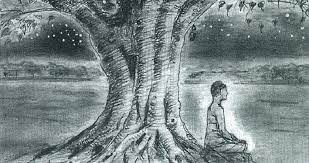
Shakyamuni tried meditation, then asceticism—subjecting his body to painful austerities—to free himself of desires. Mastering these practices left him unsatisfied, so he rejected them to seek a new, deeper path to the truth on his own. He struggled for years to conquer his own delusions about the true nature of life. In his thirties, while sitting under a Bodhi tree, Shakyamuni awakened to the fundamental truth that enables all people to overcome their sufferings. He then resolved to dedicate his life to sharing this truth with others.
Shakyamuni traveled far and wide to teach and encourage others to transform their lives and help others do the same. His disciples included people from all walks of life: from kings, warriors and merchants, to members of the lowest, untouchable class. Shakyamuni welcomed women into the Buddhist Order, treating monks, nuns, and lay men and women as equals. In the context of India’s rigid caste system, Shakyamuni’s indifference to social standing was unique. His sincere dedication sparked a people’s movement, centered on valuing and promoting the dignity of all life.
Shakyamuni taught for many years before revealing his ultimate teaching, the Lotus Sutra.
Sharing Your Buddhist Faith For Beginers.
Key points to include:
- Personal challenges:Describe a specific situation where you faced a significant obstacle in your life, like a health issue, relationship conflict, or career setback, and how chanting helped you find the courage and resilience to overcome it.
- Transformation through chanting:Explain how the practice of chanting Nam-myoho-renge-kyo transformed your perspective on the situation and allowed you to approach it with a more positive mindset.Positive changes:
- Share tangible positive changes in your life that resulted from your faith practice, such as improved relationships, increased confidence, or a greater sense of purpose.Soka Gakkai community support:
- Mention the importance of your local Soka Gakkai community and how their encouragement and support strengthened your faith journey.Kosen-rufu:
- Explain the concept of "kosen-rufu" (achieving world peace) and how your personal practice contributes to this larger goal.Structure for sharing your experience:
- Introduction:Briefly introduce yourself and how you came to practice Nichiren Buddhism.
- Personal story:Share a specific life experience where your faith made a significant impact, detailing the challenges you faced and how chanting helped you overcome them.Impact on your life:
- Describe the positive changes you've experienced in your personal life, relationships, and outlook as a result of your practice.Gratitude and inspiration:
- Express your gratitude for the teachings of Nichiren Daishonin and the Soka Gakkai community, and encourage others to explore the benefits of chanting.Important considerations:
- Be authentic: Share your story with genuine emotion and sincerity.
- Focus on the positive: Highlight the positive aspects of your faith journey and how it has enriched your life.
- Respect others' beliefs: Be mindful of different perspectives and avoid making forceful claims.
- Adapt to the audience: Tailor your sharing to fit the context and level of understanding of your listeners.

Three Thousand Realms in a Single Moment of Life
While it may be possible to accept this
idea of infinite potential in theory, in reality we tend to feel limited
in our possibilities, often resulting from a narrow view of ourselves
and the world. Our sense of values or purpose, what we tend to focus our
energies on or how we define happiness all affect how we perceive and
experience our environment. We can exist quite comfortably within a
limited view of ourselves and the world, but when challenged by a
problem or obstacle, we may suffer as a result of feeling overwhelmed,
helpless or afraid.
Three thousand realms in a single moment of life is an analytical
explanation of how differences in values, sense of purpose and view of
happiness appear as differences in one’s environment. It is a teaching
that expounds how the quality of one’s environment is determined in
response to what one considers happiness to be and the kinds of desires
one holds.
The practice of Nichiren Buddhism enables us to draw
on inexhaustible inner reserves of courage, hope and resilience to
surmount challenges and go beyond what we thought was possible. We are
also able to help others do the same. “Buddhahood” describes this
dynamic, compassionate life condition, and a Buddha is someone who has
firmly established this condition as their predominant life state. Most
people, however, are unaware of this possibility or how to actualize it.
The Lotus Sutra reveals
the ultimate truth of Buddhism, that everyone can attain this state of
Buddhahood. Based on its teachings, in the sixth century in China, Zhiyi
(the Great Teacher Tiantai) developed a philosophical system to explain
why this is possible, which he termed “three thousand realms in a
single moment of life” (Jpn. ichinen sanzen). The principle
reveals that each individual life is a microcosm of the universe and the
life condition of an individual at any point in time is reflected in
all aspects of their life, including the society in which they live and
the natural environment.
The number three thousand refers to the multitude of laws through which the ultimate reality is manifested.
Ten Worlds
The first component of the three thousand realms is the principle of the Ten Worlds,
which describes the state or condition of our lives. They are, in
ascending order of the degree of free will, compassion and happiness one
feels: the worlds of (1) hell, (2) hungry spirits, (3) animals, (4) asuras, (5) human beings, (6) heavenly beings, (7) voice-hearers, (8) cause-awakened ones, (9) bodhisattvas, and (10) Buddhas.
At
one time, it was thought that these were ten distinct and separate
realms into which beings were born. The first six of the Ten Worlds
derive from the idea of the “six paths,” an ancient Indian paradigm
concerning reincarnation. It was thought that the particular world or
state of life into which people were born was fixed for a lifetime and
determined by the things they had done in past lifetimes and that people
endlessly repeated the cycle of birth and death confined within these
six worlds.
Buddhism refined the concept of the six paths, explaining that they exist not as external worlds but as internal states.
The
world of hell indicates a state of rage arising from bitter frustration
and discontent for not being or achieving what we desire—a sense of
being imprisoned by suffering. The world of hungry spirits (the life
state of hunger) is characterized by relentless craving. The world of
animals (the life state of animality) is characterized by foolish
instinctive behavior, devoid of reason and a sense of morality. The
world of asuras is marked by animosity and perversion
(distortion of character). It is a condition dominated by ego and an
obsession with personal superiority. The world of human beings (the life
state of humanity) is a state in which we strive to control our desires
and impulses through reason and aspire for a higher state of life.
Human beings have all kinds of desires—instinctual desires, social
desires, intellectual and spiritual desires. The world of heavenly
beings is a condition of contentment and joy experienced when we fulfill
our desires through effort. However, this joy fades and disappears with
the passage of time.
The world of hell indicates a state of
misery and suffering, devoid of all freedom. The world of hungry spirits
is governed by insatiable desire. The world of animals is described
above. The world of asuras is marked by animosity, anger and
perversion. It is a condition dominated by ego and the need to surpass
others. The world of human beings is a state in which we strive to
control our desires and impulses through reason and aspire for a higher
state of life. The world of heavenly beings is a condition of
contentment and joy, though temporary because dependent upon
circumstances.
Our propensity to dwell in particular life states
is a result of the causes we have made in the past, in accordance with
the law of cause and effect, which spans past, present and future
existences. Moreover, we experience the world around us in accordance
with our life state at that moment. Therefore, even though different
people may exist in the same physical place, the inner state of their
heart, or the lens through which they perceive reality, can differ
greatly.
Buddhism teaches that if we can achieve the requisite
wisdom and insight to comprehend the true nature of our lives, we can
manifest the life state of Buddhahood—the supreme state of life
characterized by infinite compassion, wisdom and courage that is
inherent in the depths of our being. To do this, we have to make
strenuous efforts to transcend the life states of the six lower worlds.
Buddhism
identifies three further, “higher” worlds: the worlds of voice-hearers
(or learning), cause-awakened ones (or realization), and bodhisattvas.
The worlds of voice-hearers and cause-awakened ones are characterized by
partial enlightenment, an awareness of the impermanence of all things
and the instability of a life lived in the six paths. Those in the world
of voice-hearers come to this awakening through listening to Buddhist
teachings, while those in the world of cause-awakened ones awaken to
these truths on their own. Similarly, those in the world of Bodhisattva
seek after truth but go one step further by compassionately working for
the happiness of others.
The Lotus Sutra clarifies that the world
of Buddhahood, as with the other nine worlds, is equally inherent in
the lives of all people and thus is a potential open to all within this
lifetime. This is in contrast to teachings other than the Lotus Sutra,
which state that individuals have to carry out strenuous practices over
countless lifetimes in order to gradually acquire the attributes of a
Buddha.
Mutual Possession of the Ten Worlds
The Lotus Sutra is distinct from other teachings also because it
expounds the mutual possession of the Ten Worlds, clarifying that each
of the Ten Worlds encompasses all of the other worlds. This indicates
that life is not fixed in one of the Ten Worlds but at any moment can
manifest any one of them. Because of this principle, it is possible for
us to change our state of life, for although we may “inhabit” a
particular world, the other nine are present, though dormant, in our
lives.
Which of the Ten Worlds will manifest at any given moment
depends on our response to the influences in our environment. One’s life
state may fluctuate from one moment to the next, but from a broader
perspective, there is always one state or several states around which
our activities revolve and to which we are most likely to revert.
The
mutual possession of the Ten Worlds implies that all individuals have
the potential to manifest Buddhahood at any given moment. Through
continuing effort in Buddhist practice—practicing for the happiness of
oneself, dismantling one’s prejudices and mistaken beliefs, polishing
the inherent qualities of wisdom and compassion—we can solidify the
world of Buddhahood inherent within our life. Buddhahood is not an
abstract idea; it reveals itself tangibly in our daily behavior in the
form of compassion, wisdom and our efforts to establish happiness for
ourselves and others.
Attaining Buddhahood does not mean
eradicating the lower nine worlds. Instead, under the influence of our
inherent Buddhahood, the positive aspects of these worlds become
manifest, contributing to the construction of happiness for ourselves
and others.
The Ten Factors of Life
Together with the Ten Worlds and their mutual possession, the next component of the three thousand realms is the principle of “the ten factors of life.”
While the Ten Worlds describe life’s differing expressions, the ten
factors describe elements common to all things. It explains how the law
of cause and effect activates any of the Ten Worlds.
All life
equally possess the same ten factors, regardless of which of the Ten
Worlds it manifests. The ten factors are (1) appearance, (2) nature, (3)
entity, (4) power, (5) influence, (6) internal cause, (7) relation, (8)
latent effect, (9) manifest effect, and (10) consistency from beginning
to end.
The first three factors (appearance, nature and entity)
describe the life entity, which manifests the Ten Worlds. The next six
(power, influence, internal cause, relation, latent effect and manifest
effect) describe the law of cause and effect—the way in which the Ten
Worlds become manifest in the entity. Thus, a life “entity” has
attributes that can be perceived by the senses (appearance) and
attributes that cannot (nature).
The tenth factor, consistency
from beginning to end, means that the ten factors are consistent for
each of the Ten Worlds. Most saliently, this means that Buddhahood, a
life state of unwavering happiness, is inherently present in our lives
as an internal cause, and when we come in contact with a “relation” that
opens that internal cause, we fully flower and harness the workings of
the world of Buddhahood in our lives.
The Three Realms of Existence
The final component of the three thousand realms is the principle
of the “three realms of existence.” This concept views life from three
different standpoints and explains the existence of individual lives in
the real world.
The three realms are (1) the realm of the five
components (form, perception, conception, volition, and consciousness;
form corresponds to the physical aspect of life, the other four
components to the spiritual aspect), (2) the realm of living beings (the
individual living being, formed of a temporary union of the five
components, that manifests or experiences any of the Ten Worlds), and
(3) the realm of the environment (the individual environment that
supports the existence of the living being).
The three realms,
then, represent the actual world of the individual. They are not
separate but, rather, are an integrated whole which simultaneously
manifests any of the Ten Worlds.
In this way, one’s life
condition at any given moment is determined by three elements: the
mutual possession of the Ten Worlds (10 worlds × 10 worlds = 100
worlds), the ten factors of life and the three realms of existence.
Therefore, the dimensions that exist in this world are the number that
results from multiplying these elements, or 3,000. This also means that
any single life has the potential to express 3,000 dimensions.
The Boundless Possibilities of Each Person
The philosophical system of the three thousand realms in a single
moment of life provides a basis for hope, for it posits that our reality
at each moment is a function of our life state, that when our life
state changes, the world itself appears in a new light. Furthermore, it
is a philosophy that promotes engagement with others and with the
challenges of society and empowers one to squarely face and surmount
obstacles.
Life is dynamic—each moment is rich with myriad seen
and unseen possibilities. Most crucially, the world of Buddhahood is
universally inherent in all beings, and when this becomes our manifest
reality, life’s most profound possibilities, humanity’s most sublime
hopes, come into reach.
Nichiren described the principle of three
thousand realms in a single moment of life as the heart and core of the
Buddha’s teachings and established a practice to enable all people to
experience the life state of Buddhahood in their daily lives. This
practice of chanting Nam-myoho-renge-kyo with
faith in our inherent Buddha nature actualizes the principle of three
thousand realms in a single moment of life in the life of the
practitioner.
Expedient Means
expedient means [方便] (Pali upāya; hōben): The methods adopted to instruct people and lead them to enlightenment. The concept of expedient means is highly regarded in Mahayana Buddhism, especially in the Lotus Sutra, as represented by its second chapter titled “Expedient Means.” This is because expedient means are skillfully devised and employed by Buddhas and bodhisattvas to lead the people to salvation. According to the Lotus Sutra, the three vehicles of the voice-hearer, cause-awakened one, and bodhisattva are provisional teachings and expedient means designed to lead people to the one Buddha vehicle, or the teaching that leads all people to Buddhahood. The teaching that directly reveals the truth of enlightenment is called the true teaching, while the teachings that are expounded in accordance with the people’s capacity and as a temporary means of leading people to the truth are called expedient teachings or provisional teachings.
Mahayana.
Mahayana Buddhism [大乗仏教] ( Daijō-bukkyō): Buddhism of the Great Vehicle. The Sanskrit mahā means great, and yāna, vehicle. One of the two major divisions of the Buddhist teachings, Mahayana and Hinayana. Mahayana emphasizes altruistic practice—called the bodhisattva practice—as a means to attain enlightenment for oneself and help others attain it as well. In contrast, Hinayana Buddhism (Buddhism of the Lesser Vehicle, hīna meaning lower or lesser), as viewed by Mahayanists, aims primarily at personal awakening, or attaining the state of arhat through personal discipline and practice. After Shakyamuni’s death, the Buddhist Order experienced several schisms, and eventually eighteen or twenty schools formed, each of which developed its own doctrinal interpretation of the sutras.
As time passed, the monks of these schools tended toward monastic lifestyles that were increasingly reclusive, devoting themselves to the practice of precepts and the writing of doctrinal exegeses. This tendency was criticized by those who felt the monks were too conservative, rigid, and elitist, believing they had lost the Buddha’s original spirit of working among the people for their salvation. Around the end of the first century b.c.e. and the beginning of the first century c.e., a new Buddhist movement arose. Its adherents called it Mahayana, indicating a teaching that can serve as a vehicle to carry a great number of people to a level of enlightenment equal to that of the Buddha. They criticized the older conservative schools for seeking only personal enlightenment, derisively calling them Hinayana (Lesser Vehicle) indicating a teaching capable of carrying only a select few to the lesser objective of arhat. According to one opinion, the Mahayana movement may have originated with the popular practice of stupa worship—revering the relics of the Buddha—that spread throughout India during the reign of King Ashoka. In any event, it seems to have arisen at least in part as a popular reform movement involving laypersons as well as clergy.
Hinayana
Hinayana Buddhism [小乗仏教] ( Shōjō-bukkyō): One of the two major streams of Buddhism, the other being Mahayana. Teachings that aim at attaining the state of arhat. After Shakyamuni Buddha’s death, the Buddhist Order experienced several schisms and eventually split into eighteen or twenty schools. The monks of these schools were concerned with preserving the Buddha’s teachings as they understood them, and devoted themselves to doctrinal studies. As a result, they produced abhidharma works, or doctrinal treatises and commentaries on the Buddha’s teachings. Over time, however, they tended toward reclusiveness, while placing greater emphasis on asceticism and doctrinal analysis. Around the end of the first century b.c.e. or the beginning of the first century c.e., a new Buddhist movement began to emerge among those who were dissatisfied with what they perceived as the sterile academicism and rigidity of the existing schools. Feeling it was important to model their behavior after that of the Buddha himself, they advocated bodhisattva practice, or practice to benefit others, and engaged themselves in instructing laypersons while practicing among them. These practitioners called themselves bodhisattvas and their teachings Mahayana (Great Vehicle), indicating that their teaching was the vehicle to transport a great many people to enlightenment. In contrast, they referred to the earlier schools as Hinayana (Lesser Vehicle), implying that these teachings could only address a selected few and could not lead to the ultimate goal of enlightenment. The designation Hinayana was derogatory, and these schools naturally did not apply the name to themselves. The Sanskrit hīna means lesser, and yāna, vehicle or teaching. Mahayana Buddhists regarded Hinayana teachings as the way of voice-hearers and cause-awakened ones who seek their own emancipation from delusion and suffering yet lack practice to benefit others. They held that Hinayana teachings were inferior to Mahayana teachings, which set forth the way of bodhisattvas who strive to attain enlightenment for themselves and help others achieve it as well.
T’ien-t’ai
T’ien-t’ai [天台] (538–597) (PY Tiantai; Tendai): Also known as Chih-i. The founder of the T’ien-t’ai school in China, commonly referred to as the Great Teacher T’ien-t’ai or the Great Teacher Chih-che (Chih-che meaning “person of wisdom”). The name T’ien-t’ai was taken from Mount T’ien-t’ai where he lived, and this, too, became the name of the Buddhist school he effectively founded. He was a native of Hua-jung in Ching-chou, China, where his father was a senior official in the Liang dynasty government (502–557). The fall of the Liang dynasty forced his family into exile. He lost both parents soon thereafter and in 555 entered the Buddhist priesthood under Fa-hsü at Kuo-yüan-ssu temple. He then went to Mount Ta-hsien where he studied the Lotus Sutra and its related scriptures. In 560 he visited Nan-yüeh (also known as Hui-ssu) on Mount Ta-su to study under him, and as a result of intense practice, he is said to have attained an awakening through the “Medicine King” (twenty-third) chapter of the Lotus Sutra. This awakening is referred to as the “enlightenment on Mount Ta-su.”
After seven years of practice under Nan-yüeh, T’ien-t’ai left the mountain and made his way to Chin-ling, the capital of the Ch’en dynasty, where he lived at the temple Wa-kuan-ssu and lectured for eight years on the Lotus Sutra and other texts. His fame spread, and he attracted many followers. Aware that the number of his disciples who were obtaining insight was decreasing, however, and, in order to further his understanding and practice, he retired to Mount T’ien-t’ai in 575. Thereafter, at the emperor’s repeated request, he lectured on The Treatise on the Great Perfection of Wisdom and the Benevolent Kings Sutra at the imperial court in Chin-ling. In 587, at Kuang-che-ssu temple in Chin-ling, he gave lectures on the Lotus Sutra that were later compiled as The Words and Phrases of the Lotus Sutra. After the downfall of the Ch’en dynasty, he returned to his native Ching-chou and there expounded teachings that were set down as The Profound Meaning of the Lotus Sutra in 593 and Great Concentration and Insight in 594 at Yü-ch’üan-ssu temple. The three works mentioned above were all compiled by his disciple Chang-an and became the three major texts of the T’ien-t’ai school. He then returned to Mount T’ien-t’ai, where he died. Other lectures of T’ien-t’ai compiled by Chang-an include The Profound Meaning of the “Perceiver of the World’s Sounds” Chapter and The Profound Meaning of the Golden Light Sutra.
T’ien-t’ai criticized the scriptural classifications formulated by the ten major Buddhist schools of his time, which regarded either the Flower Garland Sutra or the Nirvana Sutra as the highest Buddhist teaching. Instead he classified all of Shakyamuni’s sutras into “five periods and eight teachings” and through this classification demonstrated the superiority of the Lotus Sutra. He also established the practice of threefold contemplation in a single mind and the principle of three thousand realms in a single moment of life. Because he systematized the doctrine of what became known as the T’ien-t’ai school, he is revered as its founder, though, according to Chang-an’s preface to Great Concentration and Insight, the lineage of the teaching itself began with Hui-wen, who based his teaching on Nāgārjuna and transferred it to Nan-yüeh.
Middle Way
Middle Way [中道] (madhyamā-pratipad; chūdō): The way or path that transcends polar extremes. The Middle Way also indicates the true nature of all things, which cannot be defined by the absolutes of existence or nonexistence. It transcends the extremes of polar and opposing views, in other words, all duality. However, interpretations of this concept vary considerably from one text or school to another. The three major interpretations of the Middle Way follow:
(1) In the Hinayana teachings, it is the rejection of the two extremes of self-indulgence and self-mortification. While still a prince, Shakyamuni lived in luxury in his father’s palace, but after renouncing the secular world, he abandoned worldly diversions and for years practiced as an ascetic, leading a life of deprivation and austerity. Eventually he rejected asceticism as well, and after attaining enlightenment he preached a way of life that avoids the extremes of indulgence and denial. The Medium-Length Āgama Sutra, one of the four Chinese Āgama sutras, terms this path the Middle Way. It is exemplified by the doctrine of the eightfold path.
(2) According to Nāgārjuna’s Treatise on the Middle Way, the true nature of all things is that they are neither born nor die, and cannot be defined by either of the two extremes of existence or nonexistence. This true nature of things is non-substantiality, also referred to as the Middle Way. The Treatise on the Middle Way begins: “Neither birth nor extinction, neither cessation nor permanence, neither uniformity nor diversity, neither coming nor going. . . .” This passage is termed the eight negations, or the middle path of the eight negations, and is intended to clarify the concept of the Middle Way.
(3) In terms of T’ien-t’ai’s doctrine of the three truths, the truth of the Middle Way means that the true nature of all things is neither non-substantiality nor temporary existence, but exhibits the characteristics of both.
Dharma
dharma [法] (Pali dhamma; hō): A term fundamental to Buddhism, dharma derives from the root dhri, which means to preserve, maintain, keep, or uphold. It has a wide variety of meanings, including law, truth, doctrine, the Buddha’s teaching, decree, observance, conduct, duty, virtue, morality, religion, justice, nature, quality, character, characteristic, essence, elements of existence, or phenomena.
Some of the more common usages are: (1) (Often capitalized) The Law, or ultimate truth. For example, Kumārajīva translated saddharma, the Sanskrit word that literally means Correct Law, as Wonderful Law or Mystic Law, indicating the unfathomable truth or Law that governs all phenomena. (2) The teaching of the Buddha that reveals the Law. Dharma of abhidharma means the Buddha’s doctrine, or the sutras. (3) (Often plural) Manifestations of the Law, i.e., phenomena, things, facts, or existences. The word phenomena in “the true aspect of all phenomena” is the translation of dharmas. (4) The elements of existence, which, according to the Hinayana schools, are the most basic constituents of the individual and his or her reality. (5) Norms of conduct leading to the accumulation of good karma.
The word dharma is a component of the names of many Indian Buddhist monks, including Dharmagupta, Dharmaraksha, Dharmamitra, Dharmapāla, Dharmayashas, Dharmakāla, and Bodhidharma.
Gosho
Gosho [御書] (): The individual and collected writings of Nichiren (1222–1282). Gosho literally means honorable writings; go is an honorific prefix, and sho means writings. In general the word is used in Japanese as an honorific for certain books and writings, particularly for those of the founders and patriarchs of some Buddhist schools. Nikkō, Nichiren’s successor, used the word gosho to refer to Nichiren’s works and made efforts to collect, copy, and preserve them as sacred texts. As a result, a remarkable number of Nichiren’s works have been passed down to the present, and many are extant in his own hand. In terms of content, the Gosho may be divided into four groups: (1) treatises setting forth doctrine, (2) writings remonstrating with government authorities, (3) letters offering advice, encouragement, or consolation to believers, or written in answer to questions (many in this category also include expressions of gratitude for offerings and support received), and (4) written records of Nichiren’s oral teachings, including his lectures on the Lotus Sutra.
-
Kōsen-rufu (広宣流布), a phrase found in the Japanese translation of the Buddhist scripture Lotus Sutra , is informally defined to as "wor...
-
A Bodhisattva (菩薩) is one who aspires to enlightenment, or Buddhahood. Bodhi means enlightenment, and sattva, a living being. In Hinaya...